Shaft, sterndrive or pod: choosing a drive system
How shafts, sterndrives, pods and big outboards work, what they cost to maintain, which boats use them, and what to check on a used boat.
The drive system decides how a boat handles around the marina, how much fuel it burns at cruise, how much room is left for accommodation, and what the yard bill looks like each year. On the used market it also decides which faults to look for. This guide explains the four main options for cruisers between about 8 and 25 m: conventional shafts, sterndrives, pod drives and large outboards, as of October 2026.
How each system works
Straight shafts and V-drives
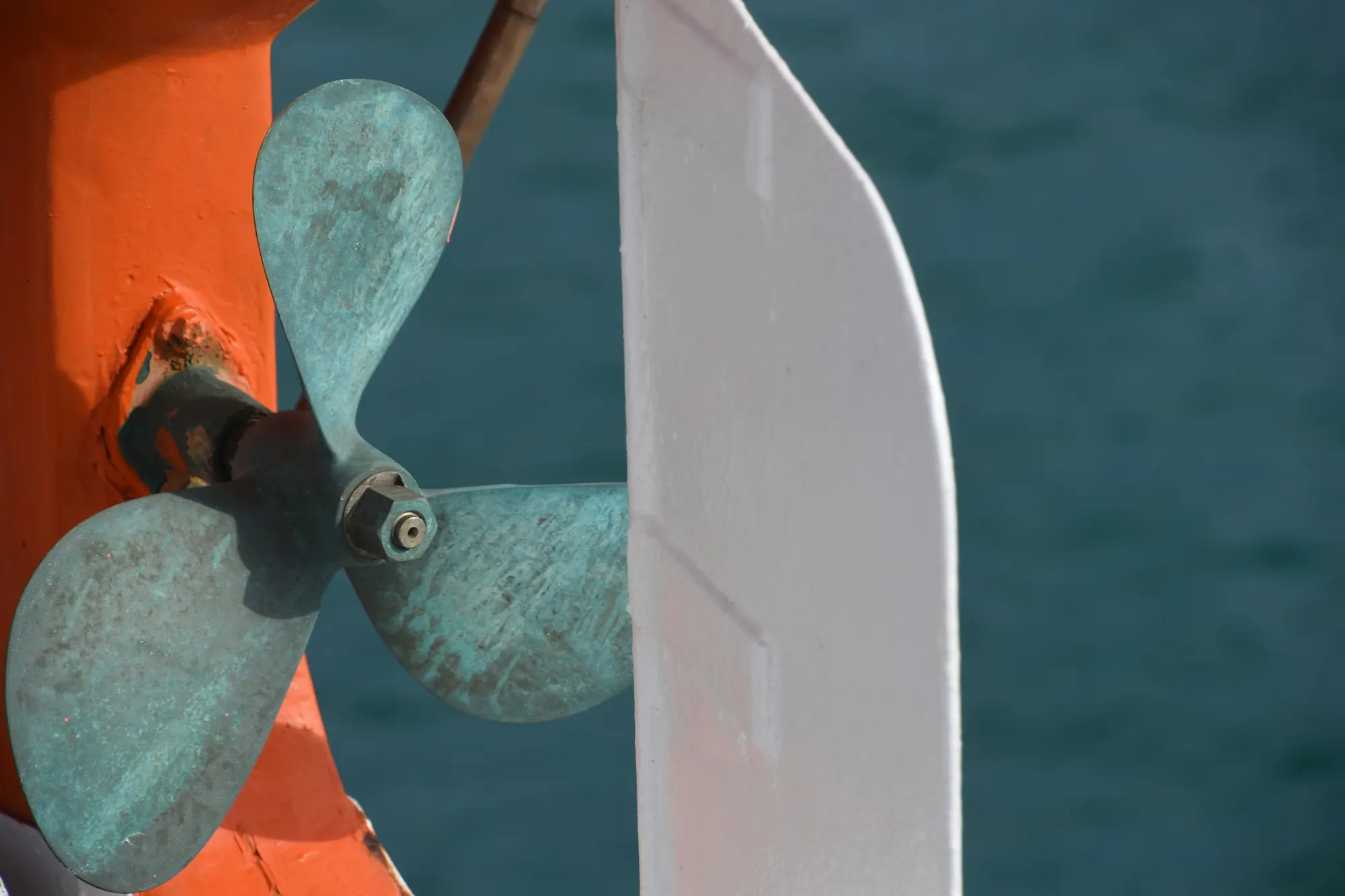
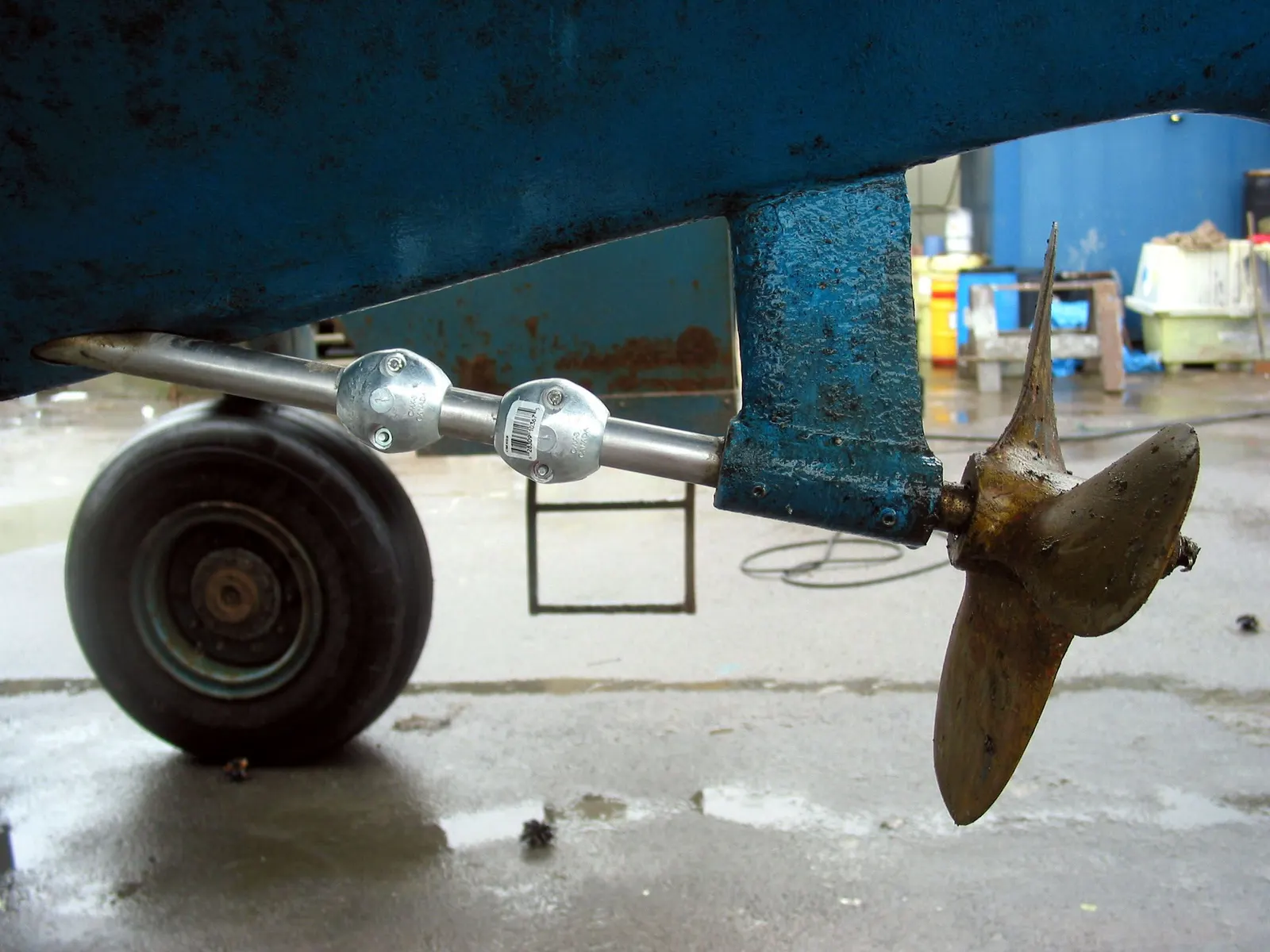
The engine sits inside the hull, usually amidships or a little aft, and turns a propeller shaft through a gearbox. The shaft leaves the hull through a stern tube with a seal, runs under the hull supported by a strut with a rubber cutless bearing, and drives a fixed propeller. Steering comes from a separate rudder behind each propeller.
A V-drive turns the drive line back on itself so the engines can sit right aft, under the cockpit, with the shaft running forward before angling down. That frees up the middle of the boat for accommodation, at the cost of a slightly more complex gearbox and tighter engine-room access.
Sterndrives
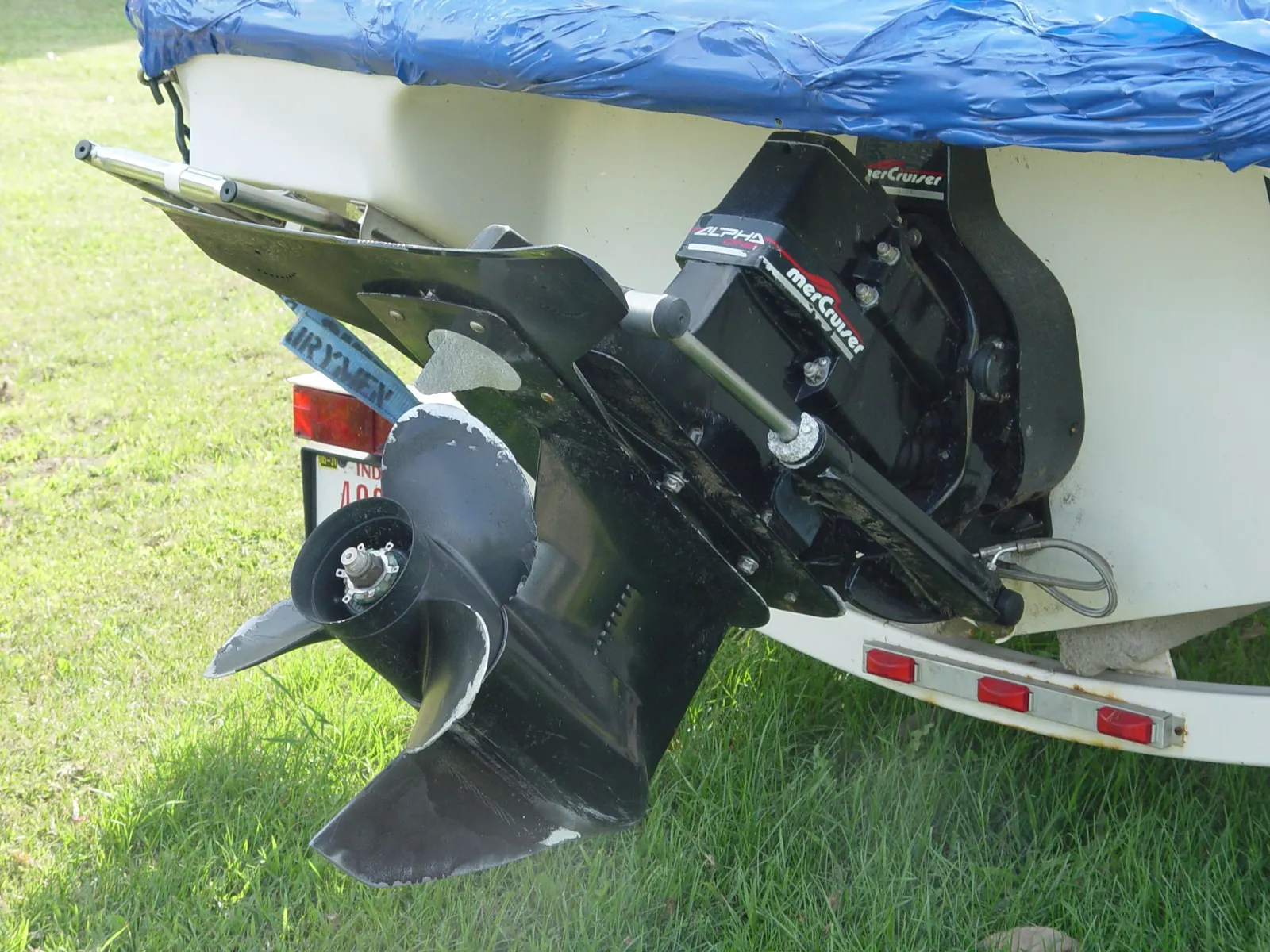
The engine sits inside the boat at the transom and drives an outboard-like leg bolted through the transom. The leg steers by pivoting and trims up and down to adjust the running angle. A rubber bellows seals the universal joint where the drive passes through the transom assembly. Mercury's Bravo Three and Volvo Penta's Duoprop use twin counter-rotating propellers on one leg for grip and straight-line tracking.
Pod drives
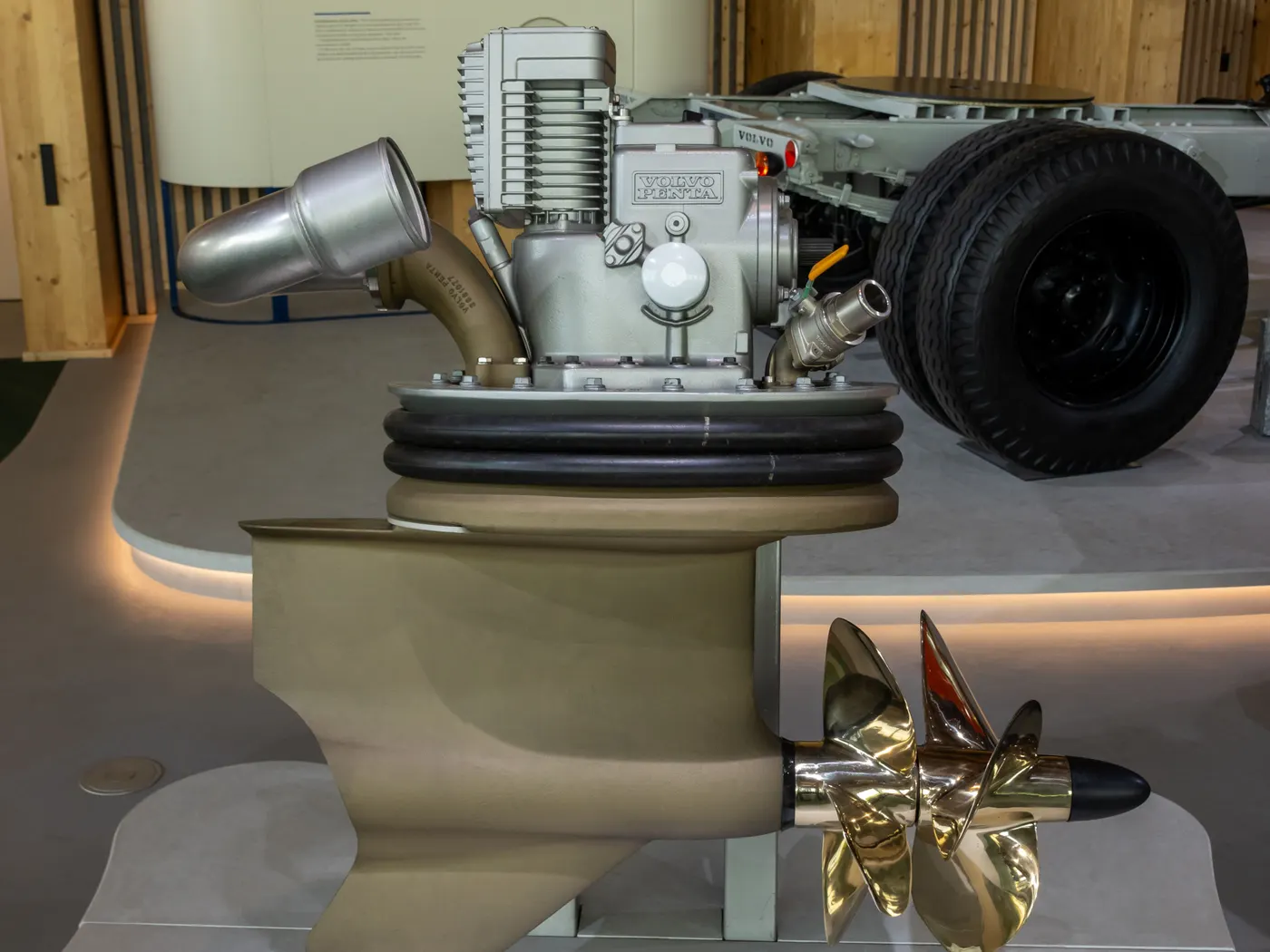
A pod is a steerable drive leg mounted through the bottom of the hull, not the transom. The engine sits close by in the engine room and drives it through a short shaft. Volvo Penta's IPS, launched in 2005, has forward-facing twin counter-rotating propellers that pull the boat, so they work in clean water ahead of the leg. Mercury's Zeus, paired with Cummins diesels, has rear-facing counter-rotating propellers and a hydraulic trim tab on each drive. Both are steered by computer and come with a joystick, which moves each pod independently so the boat can move sideways or rotate on the spot. Both systems offer GPS station-keeping that holds the boat in position while you wait for a bridge or a berth.
Outboards on larger boats
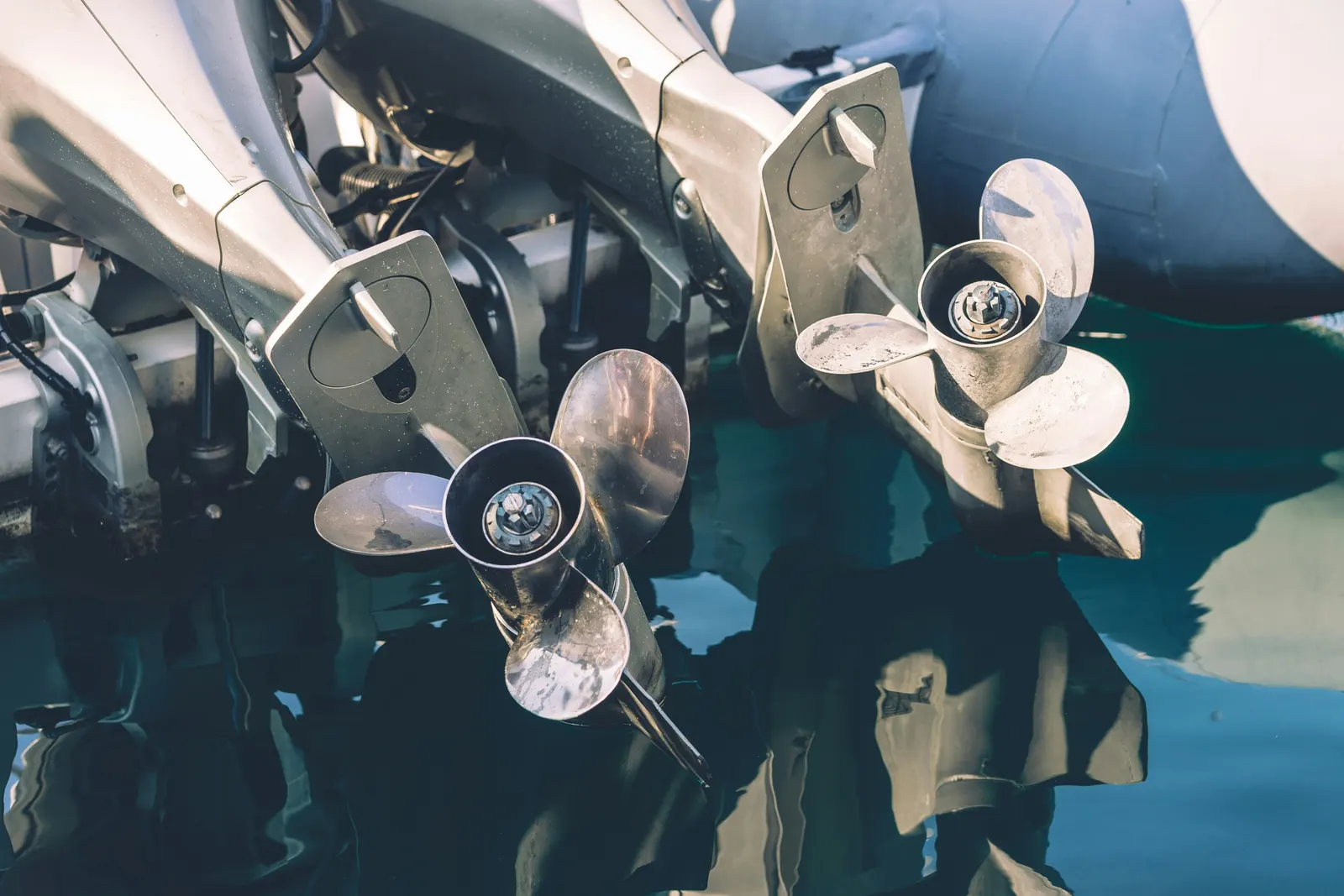
Outboards have moved up the size range. Mercury's 600 hp V12 Verado, launched in 2021, has a two-speed gearbox and a gearcase that steers while the powerhead stays fixed. Triple and quad installations now push cruisers and large centre consoles that would have had sterndrives or diesels a decade ago. Everything is out of the boat, so the hull space that would have been an engine room becomes storage or cabin.
Handling
Pods and joysticks have made big boats far easier to berth. A joystick can move a 15 m flybridge sideways into a tight pen with a single hand, which is why so many new flybridges between 12 and 20 m are now offered with pods. The trade-off is that when the electronics have a fault, close-quarters handling falls back to the throttles, and some owners never learn that skill.
Twin shafts with a bow thruster remain the traditional, predictable layout. Skippers who learned on shafts can walk a boat sideways using the gears alone. Shaft boats track well in a following sea and the rudders give positive steering at displacement speeds. Many now have an aftermarket or factory joystick linked to the thrusters.
Sterndrives and outboards steer by vectoring thrust, so they turn sharply at speed but can feel vague at very low speed, especially single-engine boats. Twin sterndrives and multiple outboards are available with joystick systems too, Mercury's Axius for sterndrives being the best known.
Efficiency
Pods are usually the most efficient at cruise, because the propellers point along the line of travel instead of angling down from a shaft, and the drive leg is streamlined. Volvo Penta claims IPS can cut fuel consumption at cruising speed by up to 30 per cent compared with a conventional inboard shaft installation. That is the maker's figure from its own comparisons; real-world savings vary with the hull and the boat. For a sense of what a modern pod-drive flybridge burns, BoatTest's test of a Riviera 50 Sports Motor Yacht with twin Volvo Penta IPS 950s recorded 166.6 litres an hour at a 22.6-knot cruise.
Sterndrives are efficient on smaller planing boats because the trimmable leg lets you set the running angle. Shafts are least efficient at high planing speeds but are reliable, long-lived, and work well on semi-displacement and displacement hulls. Outboards trade some efficiency for the space they free and the ease of replacement.
Maintenance and servicing
| System | Routine items | Typical intervals | Main cost risks |
|---|---|---|---|
| Straight shaft / V-drive | Shaft anodes, cutless bearings, shaft seals, alignment, rudder bearings, gearbox oil | Anodes every haul-out; seals per the maker's schedule; alignment checked after any grounding | Bent shaft or prop after a strike; worn cutless bearings; seal leaks |
| Sterndrive | Bellows, gimbal bearing, U-joints, drive oil, anodes, trim rams | Drive oil annually; bellows commonly replaced every five to six years | Water in the bellows, corrosion of the aluminium leg, gimbal bearing failure |
| Pod drive | Drive oil and filters, anodes, propellers, steering and trim hydraulics, software updates | IPS drive oil and filter every 400 hours or yearly; Zeus items at 500 hours or yearly | Damage from a grounding or strike, corrosion from stray current, dealer-only parts and diagnostics |
| Outboard | Engine oil and filter, gear oil, water pump impeller, anodes, spark plugs | Annually or per maker's hours | Corrosion if left down in salt water; powerhead faults; high replacement cost on big engines |
The intervals come from the makers' schedules where we could find them: the IPS figures from Volvo Penta's schedule as reproduced in a Regal owner's manual, and the Zeus figures from Mercury's schedule in another. Boat Trader quotes a factory interval of six years for MerCruiser bellows. Check the schedule for your exact engine and drive serial number, because intervals have changed over the years.
All four systems need the boat out of the water for most drive work. The haul-out itself is cheap compared with the work. At Royal Queensland Yacht Squadron, a member's travel-lift lift and launch costs A$16.08 per foot. Pod and sterndrive servicing usually costs more per drive than shaft servicing in routine years, because the parts are proprietary and the work needs dealer tools and software. Shafts cost less year to year but more when a shaft, strut or propeller has to be replaced after a strike.
As a rough planning guide, and these are our estimates rather than quoted prices: allow around A$500 to A$1,500 a year per shaft for anodes, a propeller clean and seal checks; A$1,000 to A$2,500 per sterndrive for an annual drive service, more in a year when the bellows and gimbal bearing are due; and A$1,500 to A$3,500 per pod for the drive oil, filters, anodes and checks. Big outboards fall somewhere between A$800 and A$2,000 per engine for an annual service. Labour rates, parts prices and how far the technician has to travel move these numbers a long way, so get a written quote from the dealer nearest your berth.
Which boats use which
- Volvo Penta IPS: most of the big European production flybridges and sports yachts from about 12 to 25 m, and many Australian-built flybridges and sports motor yachts, often as an option alongside shafts
- Mercury Zeus with Cummins diesels: many American sport cruisers and some sportfish and flybridge models, typically 12 to 20 m
- Sterndrives: sports cruisers, bowriders and smaller flybridges from about 6 to 13 m, petrol or diesel, single or twin
- Straight shafts: the traditional choice for flybridges, sportfishers, displacement trawlers, catamarans and most yachts over about 20 m
- V-drives: sports cruisers and flybridges where the designer wanted the engines aft to free up the accommodation
- Outboards: trailerable boats, centre consoles and a growing number of cruisers and power catamarans up to about 15 m
To see what is on the market with each drive, search listings by keyword or browse categories. For power catamarans, which have their own propulsion trade-offs, see power catamaran or monohull.
What to check when buying used
Ask for the service history in writing, with invoices, and compare the dates and hours with the makers' schedules. Then have a surveyor and a marine engineer look at the drives out of the water. Our pre-purchase surveys and sea trials guide explains how to arrange both.
Shafts: spin each shaft by hand on the hardstand and watch for wobble. Rock the shaft at the strut to check the cutless bearing for play. Look at the propeller blades for nicks, bends and repairs. Check the shaft seals for leaks and find out when they were last replaced. On the sea trial, feel for vibration through the rpm range.
Sterndrives: look closely at the bellows for cracks and ask when they were last changed. Check the drive oil for water, which turns it milky. Look for corrosion on the aluminium leg, especially around the anodes and the trim rams, and check the gimbal bearing for noise or play.
Pods: ask the dealer to connect the diagnostic software and read the fault history and engine hours. Check the drive oil and the condition of the anodes and the pod's hull seal. Look for evidence of a grounding: scraped skegs, repaired propellers or gelcoat repairs around the pod. Confirm that the boat's software is current and that the joystick and station-keeping work on the trial.
Outboards: check hours on each engine, compression on every cylinder, and the gearcase oil. Look for salt and corrosion under the cowls. On multiple-engine installations, check that the hours roughly match.
Choosing
If you value easy berthing and cruise at planing speeds, pods are hard to beat, but budget for dealer servicing and check that a qualified technician is near your home port. If you want simplicity, long service life and the ability to fix things almost anywhere, shafts remain the safe choice. Sterndrives give good value on smaller boats if you keep up with the bellows and corrosion. Outboards make sense where space and easy replacement matter more than diesel range.
The drive also feeds directly into running costs, which our guide to what a 15 m flybridge costs to own puts in context. If you are weighing hull styles at the same time, read flybridge, sports yacht or motor yacht and buying a used yacht in Australia.
Sources
- Volvo Penta, Volvo Penta IPS
- Volvo Penta, Volvo Penta unveils an upgraded IPS and DPI (2019)
- Volvo Penta IPS maintenance schedule, reproduced in the Regal 42 SC owner's manual
- Mercury Zeus stern drive maintenance, reproduced in the Regal 53 SC owner's manual
- Mercury Marine, Joystick piloting history
- Cummins, Zeus and Cummins inboard joystick
- Sail-World, Introducing the V12 600hp Verado engine
- Boat Trader, Engine outdrives - inspect those bellows
- Soundings, Zeus adds rear-facing props to mix
- Royal Queensland Yacht Squadron, Boatyard price list, November 2025
- BoatTest, Riviera 50 Sports Motor Yacht performance test
Information is general and current at the time of writing. Check with the authority or a professional before you rely on it.